Maintained Beyond FAA Standards
Every aircraft in our fleet is maintained by full-time, on-site mechanics in our own hangar at KDAB. We do not cut corners. We do not defer what needs to be done. Our students fly aircraft that are ready.
How We Approach Maintenance
Aircraft maintenance at EB Flight Training is not outsourced, not scheduled weeks out, and not treated as an afterthought. Our mechanics are a core part of daily operations.
Full-Time Mechanics
Our mechanics are not on call or shared with another facility. They are here every day, working on our aircraft. That consistent presence means issues are caught early and addressed immediately.
In-House Hangar
All maintenance is performed in our own hangar attached directly to our office at KDAB. Aircraft never leave the field for routine maintenance. Work stays close, turnaround stays fast.
Line Maintenance Available
If a squawk comes in before a flight, our mechanics are on-site and available to address it. Students and renters are not waiting days for a simple fix. Line maintenance keeps the fleet flying.
Beyond FAA Minimums
FAA regulations set a floor, not a ceiling. Our maintenance standards exceed what the regulations require. If something looks marginal, it gets replaced rather than deferred.
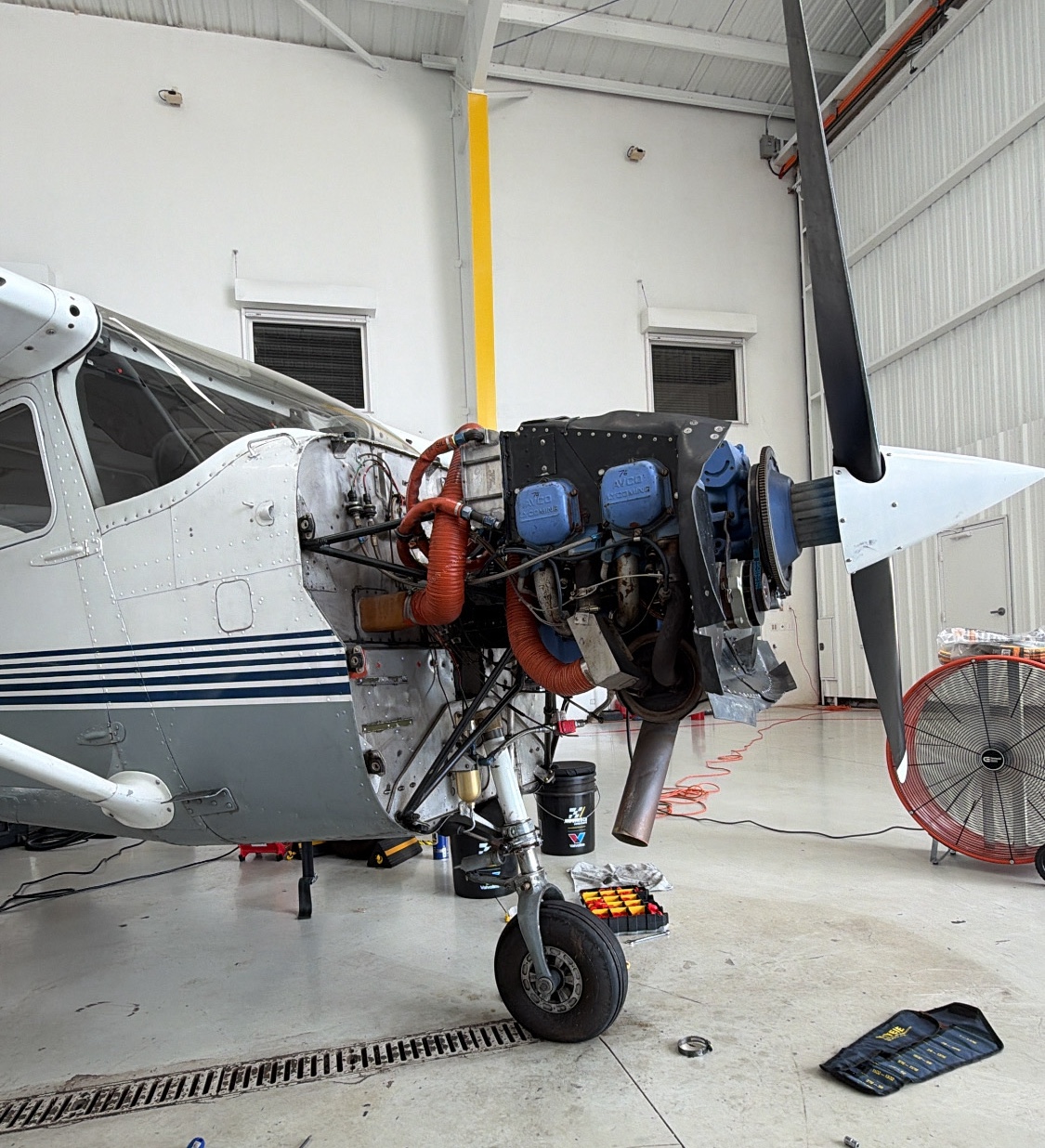
This Is What Maintenance Looks Like
This is one of our Cessnas mid-inspection in our on-site hangar at KDAB. The cowling is fully removed, the engine is exposed, and every system is checked before that aircraft goes back into service. This is a routine part of how we operate, not an exception.
Required Inspections
FAA regulations mandate a series of recurring inspections that every aircraft used for flight instruction must complete on schedule. Here is what each one involves and why it matters.
Every 50 Hours
Every 50 flight hours the aircraft is pulled into our hangar for an oil service. The cowling is removed, the oil is drained, and fresh oil is installed. We do not simply top off — we do a full drain and replace on schedule. Each oil change also includes an oil sample that is sent off to an independent laboratory for spectrographic analysis. That analysis monitors engine wear metals over time, giving us an early warning of internal component wear long before it becomes a problem in the air.
What is inspected:
- Aircraft pulled into hangar
- Cowling removed for access
- Engine oil fully drained
- New oil installed to specification
- Oil filter removed and inspected for metal
- Oil sample collected and sent for lab analysis
- Wear metal trending reviewed against previous samples
- Cowling reinstalled and secured
Every 100 Hours
Required by the FAA for any aircraft used for hire or flight instruction, the 100-hour inspection is a thorough top-to-bottom review of the aircraft. Every inspection panel is opened and critical components are checked for wear, security, and proper operation. Engine performance, flight controls, landing gear, avionics, and structural integrity are all evaluated. Because our aircraft fly regularly for flight training, each one reaches this milestone roughly once a month. The 100-hour also includes the full oil service performed at the 50-hour: the oil is drained and replaced, and an oil sample is sent for lab analysis to monitor engine wear trends.
What is inspected:
- All inspection panels opened and examined
- Engine and propeller inspection
- Oil drained, replaced, and sample sent for analysis
- Flight control rigging and freedom of movement
- Landing gear, brakes, and tires
- Fuel, oil, and hydraulic systems
- Avionics and electrical systems
- Structural inspection for cracks and corrosion
- Airworthiness directives compliance check
Every 12 Months
Every aircraft is required by the FAA to undergo an annual inspection once per calendar year, regardless of how many hours it has flown. This inspection must be performed by an FAA-certified Airframe and Powerplant mechanic holding an Inspection Authorization. The annual is more comprehensive than the 100-hour and covers the entire aircraft in detail. At EB Flight Training, this is performed in our own hangar by our full-time mechanics.
What is inspected:
- Complete airframe inspection
- Engine teardown and internal inspection
- Compression test on all cylinders
- Magneto timing and ignition system check
- All fluid systems and plumbing
- Autopilot system operational check
- Interior and exterior condition
- Return to service logbook entry
Every 24 Calendar Months
To fly in instrument meteorological conditions (IMC) or in controlled airspace under IFR rules, the FAA requires that the pitot-static system and transponder be tested and inspected every 24 calendar months. This inspection ensures the accuracy of the airspeed indicator, altimeter, and vertical speed indicator. The aircraft instruments are connected to a sensitive test device that simulates various flight conditions including different altitudes and airspeeds, verifying that the system responds correctly within FAA tolerances.
What is inspected:
- Pitot tube and static port integrity check
- Airspeed indicator accuracy verified
- Altimeter calibration at multiple altitudes
- Vertical speed indicator response check
- Static system leak test
- Transponder altitude encoding verification
- Mode C altitude reporting accuracy
- Logbook entry required for IFR currency
Every 12 Months
The Emergency Locator Transmitter (ELT) is a device that automatically activates in the event of a crash and broadcasts a distress signal to search-and-rescue satellites. The FAA requires an ELT inspection every 12 months to confirm that the unit is properly mounted, the battery is within its service life, and the transmitter is functional. A working ELT can be the difference between a timely rescue and hours of searching — we treat this inspection with the same priority as any other airworthiness item.
What is inspected:
- ELT mounting security inspection
- Battery expiration date verified
- Antenna connection and condition check
- Activation switch function test
- 406 MHz signal test (brief, controlled)
- Proper registration with NOAA confirmed
- Cumulative transmit time within limits
- Logbook entry completed
Inspection Schedule at a Glance
Each inspection type runs on its own independent clock. An aircraft can be due for multiple inspections at the same time, all of which must be completed before returning to service.
50-Hour Oil Service
Every 50 flight hours
100-Hour Inspection
Every 100 flight hours
Annual Inspection
Every 12 calendar months
Pitot-Static & Transponder
Every 24 calendar months
ELT Inspection
Every 12 calendar months
All Maintenance Done In-House
Our hangar is attached to our office at KDAB. When an aircraft needs attention, it goes straight into our shop. Our mechanics are on the field daily, available for scheduled inspections and line maintenance. You will not find our aircraft sitting at another facility waiting in a queue.